Product Profile ·
KEVA Planks
Hundreds of identical pieces of maple, no instructions, and a toy that grows without changing.
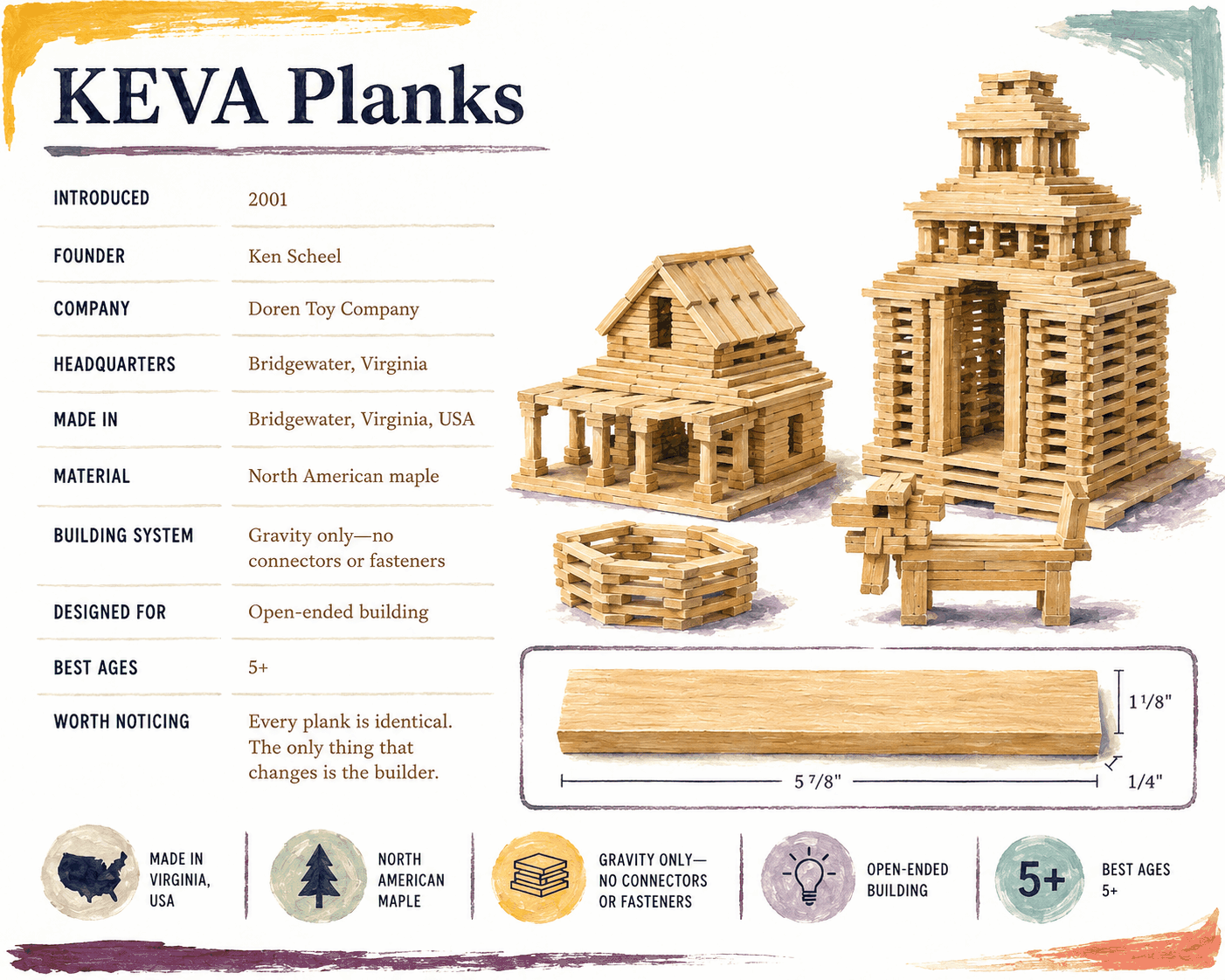
Most toys are loud.
They’re covered in bright colors, licensed characters, flashing lights, or promises printed across the box. Before they’re ever opened, they’re competing for a child’s attention.
KEVA Planks? They’re quite unassuming.
Open the box and you’ll find hundreds of identical pieces of maple. No connectors. No magnets. No special shapes. Every plank is exactly the same.
At first, there’s almost nothing to notice.
Then the building begins.
A tower becomes a bridge. A bridge becomes a city. A city becomes something else entirely. The only thing changing isn’t the product: it’s the builder.
KEVA Planks were introduced in 2001 by Ken Scheel, a veterinarian in Virginia. After discovering a similar style of wooden building plank at a toy conference, Scheel found he could no longer source it. Rather than abandon the idea, he developed his own version.
Today, KEVA Planks are still produced by Doren Toy Company, the family-owned business Scheel founded in Bridgewater, Virginia.
That continuity shows up in the product itself.
The planks are still made from North American maple. Every piece is precision cut to the same dimensions. There isn’t a “starter” piece or a “finishing” piece. There are no expansion packs to complete the experience. The same handful of simple rules has remained at the center of the product from the beginning.
The result is a toy that grows without changing.
A five-year-old may spend an afternoon stacking towers just to see how high they can go. Years later, the same box might be used to build arches, marble runs, cantilevers, or structures that seem impossible until they somehow stay standing.
Nothing about the product needs to become more complicated.
The child already has.
That may help explain why KEVA Planks have found a place well beyond the playroom. They’re used in homes, classrooms, libraries, museums, and engineering programs alike. The same box can move from one sibling to the next without feeling outgrown.
It’s easy to focus on what a toy does.
It’s just as interesting to notice what it doesn’t do.
KEVA doesn’t tell children what to build. It doesn’t reward them for following instructions. It doesn’t offer a finished story.
It simply offers the same piece of wood, over and over again, and leaves the rest to the person holding it.